Showing posts with label history. Show all posts

Tuesday, November 22, 2011

November 22, 2011 – Occupy


One can speculate but it really is not possible to really write history while it is unfolding. But as 2011 comes toward an end there is one word that history will probably most associate with this year — occupy. There is a time capsule element to the 2011 Project. The 365 pieces are meant to be looked at 20, 50 and 100 years from now and perhaps even further into the future. I feel confident in saying that the word occupy and the year 2011 will be linked together for a long time.

Monday, October 24, 2011

October 24, 2011 – Instant Communications


On this day 150 years ago Carson City, Nevada was connected to Omaha, Nebraska. With that stretch of telegraph wires, the first transcontinental telegraph line was complete. Virtually “instant” communication between the East and West Coasts became possible. Literally two days later, the Pony Express was out of business. 150 years later we’ve taken instant communications and technological advances for granted. As soon as I click the mouse today’s piece for the 2011 Project is available to anyone in the world with internet access. But it’s not just about art, this year we’ve seen what access to communications can do. Dictatorships topple and images of dead dictators go around the world in seconds.

Tuesday, October 18, 2011

October 18, 2011 – A Map to Meet Your Neighborhood Ghosts


Years ago I discovered the Sanborn Maps. They are detailed maps prepared for fire insurance purposes. They had every building in the City on them and were bound in large, cumbersome books. I’ve spent hours in the history room at the main library perusing the edition of maps from the 1880’s. Now, I can do it right from home. The 1905 edition is available online. I love cutting up old maps for my artwork. But I do set some limits for myself. I wouldn’t cut up a Sanborn map — these are digital images that have been reproduced.

With Halloween approaching the maps could come in handy if you were looking to meet some of the ghosts in the neighborhood. They reveal buildings that were in the Lower Haight in 1905. Some structures are still there and some have been replaced. The maps sometimes have details of business located in different buildings.

I have been around long enough to remember the abandoned taxi garage on Haight between Pierce and Steiner. Lofts are on that location now. But the space had a long time in the transportation business — it used to be the Haight Street Stables. Do the loft dwellers occasionally hear the heavy breathing of a draft horse or the distinct sound of its hooves?

A block north of the stables, on Page Street, there is a church in a building that used to be home to a dance academy (I’ve seen some old photos). Before that was built the street was empty except for a Chinese Laundry. I imagine the church ladies startled by a gentle tap on the shoulder and a whisper of Cantonese in their ear.

There were Chinese Laundries all over the neighborhood. One was down the street from me on Oak. And further down the block was a French Laundry that still is a Laundromat today (and one with a very sweet ghost who was the proprietress for years). Across the street at Haight and Scott is a dry cleaners that used to be a bakery (I wish the bakery would come back). The Tae Kwon Do Academy was a bicycle repair shop.

Many people mistake the old telegraph office on Page Street for a bank. We almost lost that building in the dot.com boom. The maps mark it as a Telephone Building in 1905. In the middle of that block was a windmill.

My building was built in 1927. The lot was empty before then, an outcropping of serpentine had to blasted away to fit the building into the lot. There is a church parking lot in the middle of the block where zipcars rest. One hundred years ago a “machine shop” with a gas engine was at the back of the lot. Nowadays, maybe only the ghosts remember what was made in the shop.

Friday, October 7, 2011

October 7, 2011 – El Camino Real


Yesterday afternoon I was standing in the middle of El Camino Real. No, I was not on a busy road of big box stores and strip malls on the Peninsula, nor was I standing in the middle of the 101 Freeway. I was in San Juan Bautista State Historic Park. There, below the plaza, next to the old mission is a small stretch of The Royal Road. You get a good connection to history when you stand on a dusty trail that served as a road over 200 years ago. Back then the road itself was more a series of interconnected trails linking Spanish missions and presidios. After Mexican independence the name El Camino Real fell into disuse. No Spanish king would be traveling up through Alta California any time soon. It wasn’t until the 20th Century, when California was redefining itself and mythologizing its history that the moniker El Camino Real came back into use along with the reproduction bells that line the route.

History real and re-imagined, I am glad that little bit of the old road is still there. San Juan Bautista became a quiet town bypassed by railroads and freeways. The good news is that it is now the only mission town that really feels old.

Saturday, September 17, 2011

September 17, 2011 – Emperor Norton


Most people don’t think of America as a monarchy. They assume the Declaration of Independence back in 1776 saw the end of kings and emperors. Well, not quite. In San Francisco on this day back in 1859, Emperor Norton declared himself “Emperor of these United States” as well as the “Protector of Mexico.” Now, San Francisco has been known for all sorts of eccentric characters throughout its history, but in the case of Emperor Norton, we all pretty much went along with him and to a certain extent recognized Emperor Norton as our beloved monarch.

His Highness was ahead of his time. It was Emperor Norton who called for the building of bridges to span the Bay as well as a tunnel to Oakland. Thank Emperor Norton the next time you ride BART. He issued a decree to form a League of Nations. And in 1945 the U.N was founded right in San Francisco. Some of Emperor Norton’s ideas still have not come true, but maybe in time. Emperor Norton abolished the U.S. Congress due to its corruption. In 1869 he declared both the Republican and Democrat parties abolished as well.

Monday, August 15, 2011

August 15, 2011 – Imagine a Wall


This week is the 50th Anniversary of the Berlin Wall. Yesterday’s piece for the 2011 Project was about the Berlin Wall’s rise and fall and it’s representation on maps. I have always been fascinated with the Wall, and have decided the project needs a second Berlin Wall piece.

Unless you lived through it in Berlin, I think it’s really difficult to imagine what it would be like to have your city divided by a wall. Here is what you might do. Imagine your city like I have imagined San Francisco. Get a map and draw that inconvenient and random line splitting the city.

Sunday, August 14, 2011

August 14, 2011 – Die Mauer


50 years ago this week, a wall started going up in Berlin. The wall was “permanent” and the city was divided. And then, in less than 30 years, the wall came down. Of course, there is much more to the story of the Berlin Wall, but one of the ideas I always take from it is that the lines we put on maps are never permanent. I have a pile of atlases that I recycle for my art. It did not take long to find four maps of Berlin for this piece. Before World War II, post-war, then divided with West Berlin like an island and finally a modern map showing the German capital.

Tuesday, August 9, 2011

August 9, 2011 – L’Enfant’s City


Peter L’Enfant’s city is a place that all Americans can call “our city.” L’Enfant was the civil engineer and architect commissioned by George Washington to design the nation’s capital. Ultimately the design of Washington, D.C. was a collaborative effort but the heart of the plan came from L’Enfant. Peter started using an Americanized name when serving in the Continental Army during the Revolutionary War. L’Enfant was born Pierre Charles L’Enfant in France on this day, August 9, 1754. It seems appropriate that America has a capital city designed by an immigrant.

Regardless of how one feels about the people running things in Washington, it is hard not to be impressed by the city. The streets are wide and open though still feel comfortable for pedestrians. The buildings and monuments are in many ways an expression of an imperial city yet Washington can be described as a city of accessible grandeur. The accessibility of our capital city and our country is something all Americans have to fight to maintain. The One Percenters have their lobbyists and functionaries in Washington. We have seen that they are willing to hold the country hostage for their own gain. We need to remind them that L’Enfant’s City belongs to all of us.

Tuesday, July 19, 2011

July 19, 2011 – The Edge of the World


I cut up old maps for my art. Sometimes I get a hold of old maps that are just too good to put under the knife. If I really want to use them, I make some color copies. I don’t actually own any 17th Century Maps, if I did, of course I wouldn’t be cutting those up. A few months back an anonymous neighbor left me a few postcard books of antique maps on my doorstep. Here are the results. I really love these old ones, particularly for all the mystery, exoticism and even occasional sea monsters that turn up in the edges of old maps. Living at what used to be considered the Edge of the World, I am yet to see any sea monsters or Amazons.

Monday, July 4, 2011

July 4, 2001 – Left Coast 1776


Most Americans know what happened on July 4th in 1776. We should be able to say “all Americans.” But as of late, we have seen some rather odd distortions of history, even from politicians who have managed to get elected to Congress or as Governor of Alaska. So, let’s say “most’ Americans.

One of the flaws in how we learn American history is that it is basically taught from right-to-left. The basic story goes Plymouth Rock to 1776 to the expansion westward of the United States. The New England bias was even so strong when writing the history books, that Jamestown barely gets mentioned. The basic narrative is true, but it really is only one of the many perspectives.

There is another American story for 1776. On the Left Coast in 1776 events were happening that were also playing a significant role in American History. In March 1776 the Spanish chose a patch of land at the mouth of the Golden Gate for their presidio. Then one week before the Declaration of Independence was signed, the first mission in San Francisco was founded. It was in a beautiful, warm, sheltered spot with a stream flowing into a small lake. Those were the first seeds of the city that was to become San Francisco as well as the place that was to become modern California. Those seeds pretty much lay dormant for about 70 years, but like many California natives, some plants need the right conditions to take off.

America would not be the same place it is now without what happened in Philadelphia in 1776. But it also would not be the same country without California and all the innovation (cultural, political and economic) that comes from the Left Coast.

Thursday, June 16, 2011

June 16, 2011 – Pie in the Sky


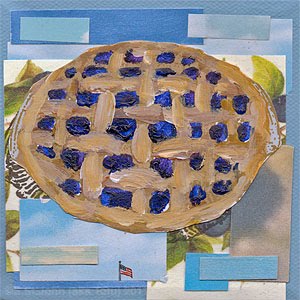
As I worked on today’s piece for the 2011 Project the image of the blueberry pie morphed into a Pie in the Sky. This made me curious. I wondered where this expression came from. It turns out it is a line in the chorus from the song The Preacher and the Slave written by Joe Hill in 1911.

And the Starvation Army, they play,
And they sing and they clap and they pray,
Till they get all your coin on the drum,
Then they tell you when you're on the bum
You will eat, bye and bye,
In that glorious land above the sky;
Work and pray, live on hay,
You'll get pie in the sky when you die

The song was written as a parody of the sort of hymns sung by the Salvation Army. The full lyrics are here. Joe Hill was a Swedish-born, American labor leader and songwriter. He was framed and then executed by the State of Utah in 1915. Not surprisingly, my America education never taught me about Joe Hill or his legacy. Rather, I learned about him when I was an exchange student in Sweden.

Tuesday, June 14, 2011

June 14, 2011 – Bear Flag


165 years ago today, in 1846, Sonoma experienced the Bear Flag Revolt and the declaration of the California Republic. The short-lived republic lasted less than a month until California was “annexed” by the United States during its war with Mexico. Mexican historians would likely tell a different version of this bit of history. Although all parties involved tend to ignore the native Californians who had been living here for thousands of years before any Europeans arrived.

The lasting legacy of the Bear Flag Revolt is our state flag. Our flag is a modern version of the flag designed in 1846 by William Todd. It featured the red star from a lone star flag from an earlier rebellion in 1936. The 1846 flag had the addition of a grizzly bear, a red bar and the words California Republic. Hypothetically, if we were to have our own country, California has a ready-made flag bearing the name California Republic. It’s been our official flag since 1911.

My favorite part of the Bear Flag’s history might be this little bit I found on wikipedia:

In 1953, the design and specifications for the state flag were standardized in a bill signed by Governor Earl Warren. The Californian state flag is often called the "Bear Flag" and in fact, the present statute adopting the flag, Gov. Code 420, states: "The Bear Flag is the State Flag of California."

Code 420 indeed! I love California.

Sunday, May 1, 2011

May 1, 2011 – An American Holiday


Today is May Day. When International Worker’s Day comes to mind, few think of the United States. For most Americans, May Day conjures up images of Cold War era Soviet Tanks parading in Red Square. We even have a government sanctioned Labor Day to distract us from the “other” day for working people. Most of us have forgotten that May Day got its start here in the United States.

In 1884, May 1 was chose as the day worker’s were to carry out general strikes and campaign for the 8-hour workday. American workers, both immigrant and American born fought and died for rights we take for granted today. On May 4,1886 a bomb exploded at a peaceful labor rally in Chicago’s Haymarket Square. It was never determined who threw the bomb (it may have been an agent provocateur or it may have been an anarchist revolutionary). In the ensuing chaos hundreds were injured and at least twelve died including eight police officers. Many of the police deaths and injuries were caused by “friendly fire.” The number of dead and injured workers has never been determined. Many feared going to hospitals for fear they would be arrested. In the aftermath seven innocent, anarchists were charged, tried and executed in trials that were widely recognized as unjust.

From this tragedy grew a day of resistance that evolved into a day to celebrate workers around the world. Over a century later May Day is an important holiday in many parts of the world, except the country where it started. America has always been a country where good ideas have originated and spread around the world. And at times it is a country where we do not know our own history.

Saturday, March 5, 2011

March 5, 2011 – Rosa Luxemburg


I find it interesting to learn about people who were famous and considered very important during their lifetimes yet somehow have been nearly written out of history. They might have been artists, composers, writers or political leaders. Rosa Luxemburg is one of those “forgotten” historical figures. A century ago, she was one of the world’s most popular and influential political leaders.

When we read a list of the names of major 20th Century leaders, the list includes people like Martin Luther King, Gandhi, Mao, Churchill, Lenin, etc., Rosa Luxemburg most definitely should be included. In 2011 one probably needs to be a fairly serious scholar to be familiar with her legacy. Even all my lefty college professors never mentioned her. I first learned about Rosa Luxemburg from Margarethe von Trotta’s 1986 film.

During her lifetime, Rosa Luxemburg was big — very big. She attracted huge crowds wherever she spoke. I’ve often heard it repeated that she was as big as Lenin. She was a socialist thinker, militant anti-war activist and a major leader in worker’s revolutionary movements in Europe. After World War I, Rosa Luxemburg was assassinated in January 1919 in Berlin during the chaos of the attempted socialist revolution.

One could write a thesis (someone probably has) on why history has forgotten Rosa Luxemburg. And there is that line about history being written by the victors, but ultimately I feel Rosa Luxemburg has been disregarded because of her gender. No matter the ideology, we have a long way to go to recognize women as leaders equal to men.

In the post-Soviet world, many are quick to disregard any thinking with a hint of Marxism. I think it’s quite a mistake to throw out the red baby with the bathwater. There is a great deal to learn from history and about the state of the current world by reading philosophers like Luxemburg. Some of the things Rosa Luxemburg wrote a century ago are quite relevant today. Even a quick search online finds a quote of hers that could just as well be about Egypt or Libya today as it was about Europe a century ago:

The modern proletarian class does not carry out its struggle according to a plan set out in some book or theory; the modern workers' struggle is a part of history, a part of social progress, and in the middle of history, in the middle of progress, in the middle of the fight, we learn how we must fight.

Monday, February 7, 2011

February 7, 2011 – Soviet Union


Today is a good day to remember nothing on a map is permanent. On this day in 1990, the Central Committee of the Soviet Communist party voted for the dissolution of the Soviet Union. I am endlessly fascinated by how maps change. I often use old, out of date maps in my work. Borders are one of the most permanent man-made things that are not actually permanent. Even a few years before it happened, the collapse of the Soviet Union was hard to imagine.

Ironically enough, we’ve just experienced a barrage of revisionist history tied into the 100th birthday of Ronald Reagan, or Raygun as many of us remember him. One would think today’s anniversary would be noted, if not celebrated by conservatives. But even for the perceived winners, the collapse of an empire can be unsettling. Particular an empire, that at 70, felt as solid and stable as an old Russian granny. Enough said, let’s just remember, maps do change from time to time.

Friday, January 28, 2011

January 28, 2011 – Radio


No matter how old we are, radio has always been a part of our lives. Maybe that is why it will take some effort to let it go. It’s had a good run, a nice healthy century. But the life of radio is coming to an end. In many ways, radio was really the beginning of the rapid acceleration of technology that has marked all of our lives.

KUSF, a local college radio station, was abruptly shut down by the University of San Francisco this month. The dedicated volunteers who staffed the station, as well as their listeners, are understandably, quite distressed. While I sympathize with their loss, it does not mean much for me on a personal level. About the only time I listen to broadcast radio anymore is a bit of NPR on a road trip. Radio stations do not have a significant role in my life anymore.

I was also thinking about radio for another reason today. Today is the 25th Anniversary of the space shuttle Challenger disaster. I was living in Switzerland in 1986. I found out about the disaster when I came home from class and turned on the radio. In those days radio was my main source of media (I did not have a TV).

When I first arrived in Switzerland, I diligently listened to German language radio. When setting up my phone service, I naïvely admitted to owning a radio. As soon as I saw the tax bill for radio service, I went to the post office with a great tale about exploding radios and American electrical converters. “Oh no, I was not getting a new radio.” Yes, I was one of those immigrants the Swiss complain about. Truthfully, I never listened to Swiss radio. Much to my surprise, I grew to prefer AFM, the U.S. Armed Forces Radio. I had a year where I seldom had the opportunity to speak English. That is when I finally understood why many immigrants need a radio station in their native language. Sometimes we just need to hear your own language.

Immigrants still depend on radio, but today it mostly is via the internet. I myself am an avid internet radio listener, but what we call “radio” today is no longer the box that many older people used to call “the wireless.”

For today’s piece I used an image of this cute, little, retro transistor radio. I bought it years ago at a yard sale. It’s is labeled a “boys radio.” It normally sits with some kitsch on the bathroom shelf. I’ve had it for over 10 years. Never even put batteries in it, I am not sure if it would even work. But it is cool.